
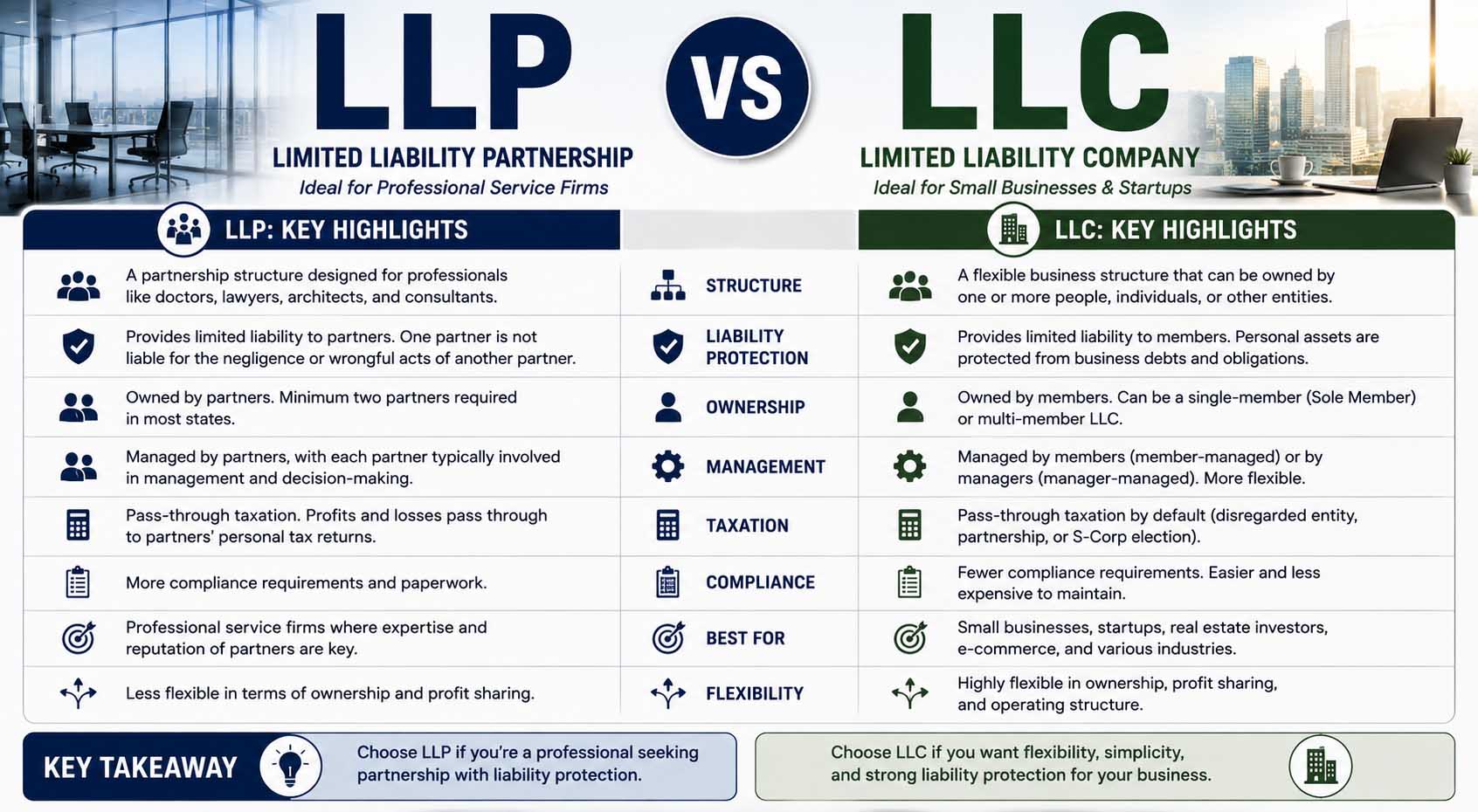
LLP vs LLC: Key Differences and How to Choose
Choosing a legal structure is one of the first major decisions business owners make, and the LLP vs LLC comparison often comes up when two or more people plan to operate a business together. Both structures can offer liability protection and flexible management, yet they work differently. An LLC is widely available to many kinds of businesses, while LLP availability and rules depend heavily on the state and, in some places, the profession involved.
So, which structure makes more sense? The answer depends on who owns the business, what kind of work it performs, how the owners want to manage it, applicable state law, tax goals, and the level of liability protection required.
Because business-entity and tax rules vary by jurisdiction and can change, owners should verify current state requirements and consider professional legal or tax advice before forming an entity.
What Is an LLP vs LLC?
An LLP, or limited liability partnership, is a type of partnership that provides partners with a degree of personal liability protection. The exact protection varies by state. LLPs are commonly associated with professional businesses, such as accounting, legal, architectural, or consulting practices, although eligibility differs across jurisdictions.
An LLC, or limited liability company, is a separate legal entity formed under state law. It can have one owner, known as a member, or multiple members. Depending on applicable rules, individuals and various business entities can potentially be members.
The key distinction starts with their underlying structures: an LLP is a partnership form, while an LLC is a limited liability company.
Anyone comparing partnership structures may also find the benefits of partnership useful to understand because shared ownership can provide combined expertise, resources, and decision-making capacity, although it can also create disagreements if roles are unclear.
LLP and LLC at a Glance
Although specific rules vary by state, this quick comparison shows the general differences.
| Feature | LLP | LLC |
|---|---|---|
| Basic structure | Partnership | Limited liability company |
| Number of owners | Generally two or more partners | One or more members |
| Liability protection | Available, but scope varies by state | Generally protects members from many business liabilities |
| Management | Usually handled by partners | Member-managed or manager-managed |
| Federal income tax default | Usually partnership taxation | Depends on number of members |
| Availability | State-specific; sometimes profession-specific | Broadly available in all U.S. states |
| Ownership terminology | Partners | Members |
| Formation document | Varies by state | Usually articles/certificate of organization |
| Best suited for | Often professional or partnership-based firms | Wide range of businesses |
These are general characteristics rather than universal rules. Therefore, entrepreneurs should check the laws of the state where they plan to organize the business.
How Liability Protection Differs
Liability protection is usually one of the biggest reasons entrepreneurs compare these two structures.
LLC Liability Protection
An LLC generally separates the company’s liabilities from the personal assets of its members. Therefore, a member normally isn’t personally responsible solely because they own the business for debts and obligations belonging to the LLC.
However, limited liability is not absolute.
An owner may still face personal liability for their own wrongdoing, personally guaranteed debts, certain tax obligations, or circumstances in which legal protections do not apply.
Maintaining proper business records, keeping business and personal finances separate, following required formalities, and signing agreements in the company’s name can help preserve the distinction between owner and entity.
These protections explain why liability separation often appears among the benefits of an llc for entrepreneurs moving beyond informal business arrangements.
LLP Liability Protection
An LLP can also protect partners from certain partnership liabilities. However, the scope of protection depends on state law.
In many situations, one attraction of an LLP is that a partner may receive protection from obligations arising from another partner’s actions. Still, partners generally remain responsible for their own professional misconduct or wrongful acts.
Professional liability rules can add another layer. As a result, lawyers, accountants, architects, healthcare professionals, and other licensed professionals should check the specific rules governing their profession and jurisdiction.
Ownership and Management Differences
LLCs offer considerable management flexibility.
A member-managed LLC allows the owners to participate directly in operating the business. Alternatively, a manager-managed LLC lets designated managers handle day-to-day operations.
This flexibility can work well for businesses where some investors want ownership without managing daily activities.
An LLP usually follows a partnership-style approach. Partners often participate in management unless their partnership agreement establishes another arrangement.
For example, four accountants could create an LLP and divide responsibility for client acquisition, staffing, finance, and operations among themselves.
In either structure, a detailed operating or partnership agreement can reduce uncertainty. It can explain voting rights, profit distributions, responsibilities, admission of new owners, dispute procedures, and what happens when an owner leaves.
LLP vs LLC Tax Benefits
Searches for LLP vs LLC tax benefits often assume one structure automatically produces lower taxes. In reality, the answer is more nuanced.
For U.S. federal income tax purposes, an LLP with multiple partners is generally taxed as a partnership unless another classification applies. The partnership typically files an informational return, while income, deductions, gains, and losses pass through to the partners according to applicable tax rules.
An LLC has more potential federal tax classifications. The IRS guidance on limited liability companies explains how federal tax treatment can depend on the number of members and elections made by the business.
By default, a single-member LLC is generally disregarded as an entity separate from its owner for federal income tax purposes, while a domestic multi-member LLC is generally treated as a partnership. However, an eligible LLC can elect corporate tax treatment, and qualifying entities may elect S corporation status.
That flexibility is one reason entrepreneurs sometimes compare the difference between llc and s corp. An LLC describes a state-law business entity, whereas S corporation generally refers to a federal tax election rather than a completely separate state-law entity type.
Taxes depend on much more than the entity’s name. Income level, payroll, ownership, deductions, state taxes, self-employment tax rules, and tax elections can all affect the outcome. Therefore, personalized tax advice can be valuable before choosing solely for tax reasons.
LLC vs Sole Proprietorship
A solo entrepreneur may not need to spend much time considering an LLP because an LLP generally requires a partnership.
Instead, that owner may compare an LLC with operating without a separate business entity.
Understanding the difference between sole proprietor and llc can help clarify this decision. A sole proprietorship generally does not create a separate legal entity between the owner and the business, while an LLC creates a state-law entity that can provide liability separation when properly formed and maintained.
A single-member LLC can therefore be attractive to freelancers, online sellers, consultants, property owners, and many other solo businesses.
By contrast, an LLP becomes relevant when multiple partners want to operate through a partnership structure and the jurisdiction allows that business to register as one.
Formation and Ongoing Requirements
Both structures require more planning than simply agreeing to work together.
Forming an LLC
The exact process varies by state, but LLC formation commonly involves:
- Choosing an available business name.
- Selecting a registered agent.
- Filing formation documents with the state.
- Paying the required filing fee.
- Creating an operating agreement.
- Obtaining an EIN when required or useful.
- Registering for applicable licenses and taxes.
Some states also impose annual or periodic reports, fees, franchise taxes, or similar obligations.
Forming an LLP
An LLP usually starts with an underlying partnership. The partners then complete the registration required by their state to obtain LLP status.
Depending on the jurisdiction, requirements may include filing a statement or registration form, paying fees, maintaining a registered agent, renewing registration, or meeting professional licensing requirements.
Because state rules differ, never assume that an LLP available in one state works identically in another.
Colorado LLC vs. LLP
The search for Colorado LLC vs. LLP illustrates why location matters.
Colorado recognizes both LLCs and registered limited liability partnerships, but entrepreneurs should review the current requirements of the Colorado Secretary of State and any profession-specific rules before choosing.
The same principle applies nationwide.
For example, a structure that works well for a consulting firm in Colorado might face different registration, professional-licensing, tax, or liability considerations in California, Texas, New York, or another state.
Therefore, state-specific research should be part of the formation process rather than an afterthought.
When an LLP May Make More Sense
An LLP may be worth considering when several professionals want to operate together as partners while receiving liability protection available under state law.
For instance, imagine three accountants establishing a practice. Each wants an active role in management, and they prefer a traditional partnership framework.
If their state permits their profession to use an LLP, the structure may align well with their needs.
An LLP may also appeal to existing partnerships that want to preserve partnership-style governance rather than convert to another entity type.
Still, the partners need a strong partnership agreement. Liability protection does not prevent disputes over workload, compensation, client ownership, voting, or profit distribution.
When an LLC May Be the Better Fit
An LLC may be more practical when owners want broad structural flexibility.
For example, two people starting an e-commerce company may prefer an LLC because they can establish ownership percentages, choose a management arrangement, and potentially consider different federal tax classifications as the company develops.
An LLC can also accommodate a single owner, which gives it an advantage for solo entrepreneurs.
Meanwhile, companies expecting substantial outside investment should consider their long-term financing plans. Venture investors sometimes prefer corporations for reasons involving stock ownership and financing structure. Reviewing corporation advantages and disadvantages can therefore be useful before choosing an entity for a business designed to raise institutional equity.
LLP vs LLC: Advantages and Drawbacks
Neither option is automatically better.
LLP Potential Advantages
An LLP may offer:
- Partnership-style management
- Liability protection under applicable state law
- Pass-through federal taxation in the typical partnership setup
- A familiar structure for certain professional firms
- Direct involvement by partners
However, LLP eligibility can be limited. Protection also varies by jurisdiction, and professional partners can still be personally responsible for their own misconduct.
LLC Potential Advantages
An LLC may offer:
- Broad availability
- Single-member or multi-member ownership
- Flexible management
- Liability separation
- Several possible federal tax classifications
- Suitability for many industries
On the other hand, state fees and compliance requirements vary. Some states impose taxes or charges that can make an LLC more expensive than expected.
Common Mistakes When Choosing a Structure
One common mistake is choosing solely based on tax assumptions.
Business owners sometimes hear that one structure “saves more tax” without considering income, payroll, state rules, ownership, or tax elections. Consequently, a choice that works for one business may be inefficient for another.
Another mistake is ignoring future ownership changes.
If you expect to bring in investors, add partners, sell ownership interests, or expand across states, consider those plans before forming the entity.
Owners also sometimes overlook governing agreements. Even when a state does not require a detailed internal agreement, putting responsibilities and procedures in writing can prevent major disputes later.
Finally, do not assume liability protection replaces insurance. Depending on the business, general liability, professional liability, property, cyber, workers’ compensation, or other coverage may still be appropriate or required.
How to Choose Between an LLP and LLC
Start with eligibility.
First, check whether your state permits your type of business or profession to form an LLP. If it does not, the decision becomes much simpler.
Next, consider the number of owners. A solo owner can generally form an LLC, whereas an LLP is fundamentally a partnership structure.
Then compare liability rules. Because LLP protection differs among states, examine exactly what liabilities partners receive protection from.
After that, review taxation with a qualified professional. Look beyond federal income taxes and consider state taxes, payroll obligations, self-employment taxes, fees, and possible elections.
Finally, think several years ahead. Your ideal structure should support not only today’s operations but also expected hiring, ownership changes, expansion, financing, and succession plans.
FAQs
Is an LLP the Same as an LLC?
No. An LLP is a limited liability partnership, while an LLC is a limited liability company. They have different ownership structures, formation rules, and legal frameworks.
Which Is Better, LLP or LLC?
Neither is universally better. An LLP may suit certain multi-owner professional practices, while an LLC works for a wider variety of businesses and can have one or multiple owners.
Can an LLP Have One Owner?
Generally, an LLP requires at least two partners because it is a partnership. Exact requirements should still be confirmed under applicable state law.
Does an LLC Pay Less Tax Than an LLP?
Not automatically. Tax results depend on federal classification, state rules, business income, owner circumstances, payroll, deductions, and available elections.
Can Professionals Form an LLC Instead of an LLP?
Sometimes. However, professional entity rules vary significantly by state and profession. Some jurisdictions require or offer specialized structures such as professional LLCs or professional corporations.
Does an LLP Protect Partners From Lawsuits?
An LLP can provide liability protection, but the scope varies by jurisdiction. Partners generally should not assume they are protected from liability for their own professional negligence or wrongful conduct.
Making the Choice for Your Business
The LLP vs LLC decision becomes easier when you focus on the business rather than the labels. An LLP can make sense for eligible partners who want a partnership structure with liability protection, while an LLC offers flexible ownership and management for a much broader range of businesses.
Before filing, compare your state’s eligibility rules, liability protections, formation costs, annual requirements, and tax consequences. Then consider how the business may change over the next several years.
A few hours spent checking those details with the appropriate state agency and qualified legal or tax professionals can help you choose a structure that fits both your current operations and your longer-term plans.